FASCINATING LANDSCAPES AND DIVERSE CULTURES
The Southern Tier Route can be ridden between early fall and late spring. In September and May, there still might be some very hot weather
to contend with at either end of the route. Note that snow can occur at any time in the higher elevations in the Southwest during the
winter, and the highest pass in New Mexico is over 8,000 feet. If you are doing a winter trip, remember that you will have short daylight
hours. Due to changing local conditions, it is difficult to predict any major wind patterns, but here are a few known observations. In
California, dry easterly winds predominate in the fall, blowing west from the desert. In western Texas, winds from the Gulf of Mexico will
cause headwinds for eastbound riders. Be aware that hurricanes can occur from July through November along the Gulf Coast of the Florida
panhandle and can also hit the Atlantic seaboard.
After climbing away from San Diego on the California coast and topping out at 3,800 feet, the desert appears. The route travels through the
Yuha Desert and the below-sea-level, irrigated Imperial Valley, before splitting the Algodones Dunes Wilderness Area in half. In Arizona,
the snowbirds abound as the route travels through Phoenix and its surrounding communities, and the copper-mining towns of Miami and Globe.
The Boyce Thompson Arboretum State Park east of Superior and the Besh Ba Gowah Archeological Park in Globe are attractions not to be
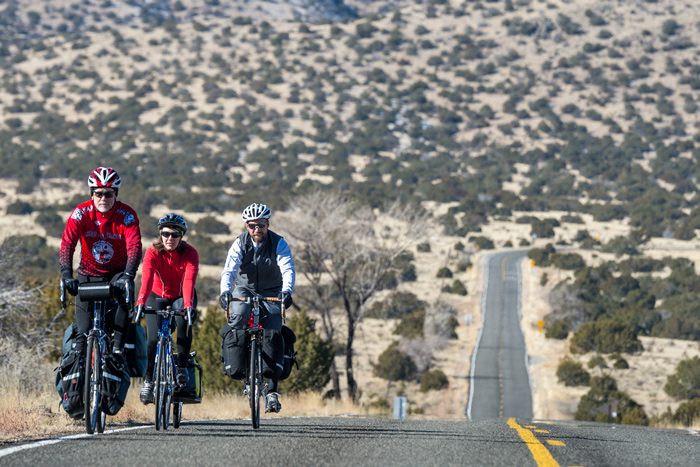
missed. You'll be riding through dry, sparsely populated ranch country where every town will be a welcome sight and a chance to top off
your water bottles. New Mexico offers Silver City for the latte drinkers, along with the Gila Cliff Dwellings National Monument, some of
the best preserved Mogollon cliff dwellings around.
The ride along the Rio Grande into El Paso, Texas, is a treat for
bird lovers, especially during migration season, when the birds are
flying north or south. Texas dominates this route, taking up an entire third of the mileage. Starting in El Paso, just across the Rio Grande
River from Juarez, Mexico, the route follows the river southward
before turning east and heading through the Davis Mountains, where
some of the friendliest folks on the whole route reside. You'll pass
the McDonald Observatory atop 6,800-foot Mt. Locke. There's a visitor
center with daily tours, and evening "Star Parties" three days per
week. After the Davis Mountains, towns are few and the country desolate,
full of sagebrush and tumbling tumbleweeds. As you travel through
central Texas, the terrain starts to feel like the Alps, but this
is actually the famous "hill
country." This diverse area serves some great barbeque and is the training ground for Lance Armstrong, seven-time Tour de France winner. If you
take the alternate route through Austin, make sure you go hear some of the diverse
music available at the nightclubs on Sixth Street.
Louisiana is like no other state in the United States due to its history, language, culture, and food. First of all, they have parishes
instead of counties. Traveling right through the middle of Cajun country, in places like Mamou, a stop in a cafe is a trip unto itself. The
crowd is speaking English, but you can't understand the words. Try to hear some lively Cajun music if you have the time. Mississippi offers
rural riding all the way into Alabama, where the route crosses a bridge to Dauphin Island. From there it's a ferry ride across Mobile Bay
to Gulf Shores and some of the whitest beaches in the world. If the ferry is closed due to inclement weather, you will have to take the alternate route through
Mobile.
The scenery varies greatly across Florida, from the historic coastal city of Pensacola to the alligator-filled waters of the area around
Palatka. The route ends in St. Augustine, a city full of interesting buildings and the Castillo de San Marcos, a fort that has guarded the
city's waterfront for over three centuries.
Terrain
The route offers challenging terrain right from the start, with some longer climbs leaving San Diego all the way up to In-ko-pah Pass,
about 70 miles east of the Pacific coast. There are two mountain passes in New Mexico, the highest being Emory Pass at 8,228 feet, which is
also the route's highest point. The route just north of Silver City, New Mexico, which goes to the Gila Cliff Dwellings National Monument,
offers some steep, challenging, rolling mountains, as does the hill country west of Austin, Texas. East of Austin the route flattens out as
it meanders through piney woods, by bayous, along farmlands and woodlots, and past the Gulf Coast all the way to the Atlantic Ocean.
Logistics
Isolated stretches, especially in the western states of California, Arizona, New Mexico, and Texas are not uncommon. Services are
infrequent and can dictate long miles on some days. The 144-mile stretch from Marathon to Comstock, Texas, calls for specific planning and
carrying of food and water. Bike shops are not as plentiful as one would like, and there are none for the 450 miles between El Paso and Del
Rio, Texas. There are also none between Bastrop, Texas, and Orange Beach, Alabama (870 miles), unless you go off route into Baton Rouge,
Louisiana, or Mobile, Alabama.
Go to Top
|
|