|
Great Divide Mountain Bike Route
|
THE GREAT DIVIDE IN CANADA
Because June is typically a wet month in the northern Rockies, and often a cold one at the higher elevations, we recommend that you do not
attempt this ride prior to late June or early July. High-country snowpack may prevent certain portions from being passable until then,
anyway. Concerning the other end of the cycling season in the Canadian Rockies, plan on being off the trail by mid-October at the latest.
Regardless of when you strike out or how long you intend to be there, pack along raingear and cold-weather clothing. Snow or cold rain is
possible any day of the year at some of the elevations encountered, and hypothermia is an ever-present possibility.
Character of the Route's Regions North To South
The route begins behind the magnificent Banff Springs Hotel in Banff, headquarters for the national park of the same name. Considering the
hotel's size and its teeming crowds, you may find it surprising how quickly the Spray River Trail--an old fire road, actually--whisks you
into country possessing a very wild and remote feel. (Signs acknowledging that you've entered grizzly bear territory are no doubt partially
responsible for this feeling.) A climb up the Goat Creek Trail takes you to the Smith-Dorrien Spray Road, a primary, and potentially dusty,
backcountry tourist route. The incredible scenery continues through Kananaskis Country and its Peter Lougheed Provincial Park. From there,
a tough climb up and over the Great Divide via a powerline route through the Elk Pass delivers you to Elk Lakes Provincial Park. It's a
six-mile (9.6 km) ride from one trailhead to the other that would require more than 200 miles (322 km) of driving if you had to do it in a
car on roads! Subsequently, a 40-mile-plus (64 km) dirt road leads to Elkford, by way of a wilderness corridor where you'll want to keep
an eye out for big moose and even bigger logging trucks.
There's a long climb on pavement out of Elkford to the narrow Fording Road, whose gravel surface leads through Tembec Forest Research
Management units around the back side of Fording Mountain. Then, following a brief stretch on Highway 43, the smooth pavement of Lower
Valley Road twists through a rural residential area outside Sparwood. From there, a 14-mile (22.5 km) stretch of highway riding is
required. Traffic can be heavy, but the road generally has a decent shoulder to ride on.
The booming ski-resort town of Fernie makes a great place for a layover, with its copious motels, sporting goods stores, restaurants,
and hiking/mountain-biking trails. From there, back roads wind through stands of conifers and poplars to Elko (watch for the occasional
sign marking the TransCanada Trail). A dizzying and delightful series of paved and gravel byways, one of which proffers a brief glimpse
down on the immense Lake Koocanusa, then wend their way to Grasmere. From there, it's a seven-mile (11 km) ride on the highway to the
international border and the northern terminus the U.S. Great Divide Mountain Bike Route.
Terrain
The elevations encountered on Great Divide Canada are relatively low when compared to those along the Great Divide Route in the central
Rockies of the United States, where riders must tackle mountain passes of nearly 12,000 feet above sea level. The high point on Great
Divide Canada, Elk Pass, is a mere 6,443 feet. Generally, road quality is quite good, although you'll find that surfaces range from smooth
pavement to rutted dirt, where you'll be thankful that you're riding a mountain bike and not a road bike. As a rule, if you're not riding
uphill, then you're headed downhill. This is especially true in Map A, whereas Map B covers some flatter terrain.
Remoteness Equals Limited Services
Great Divide Canada features some of the most magnificent and forbidding mountain country you'll ever see--anywhere. You'll need to deal with a
couple of long stretches without basic services--particularly on Map A, between Banff and Elkford. Careful planning will be
required to ensure that you have enough food to get you through (though surface water and primitive campgrounds are plentiful). With the
exception of large grocery stores in Banff, Sparwood, and Fernie, you'll find food sources to be small-town establishments, often more akin
to convenience stores than to supermarkets; consequently, you may find it necessary to exercise flexibility when it comes to menu planning.
Also be aware that showers, flush toilets, potable water, and laundromats can be few and far between. It's wise to have some back-country
camping experience before riding Great Divide Canada, and you'll also want to know the recommended precautions to take when camping and
traveling in bear country.
Tough on Equipment
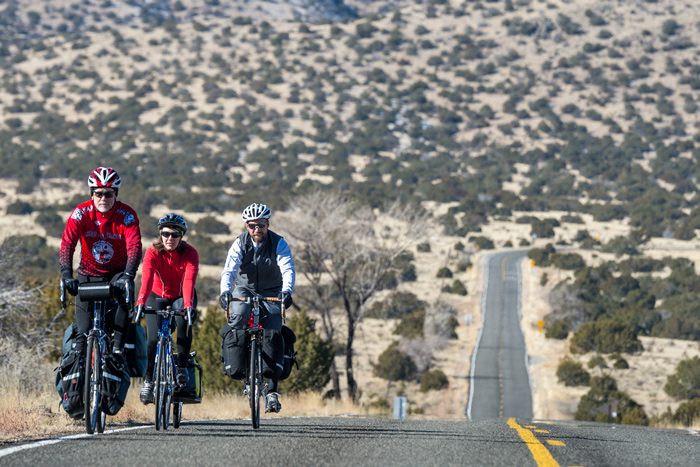
The Great Divide Route is very hard on equipment. The weight of your gear exponentially multiplies the stress of riding steep,
fast, rough downhills. Wheels, tires, and drivetrains (chains, cassettes, bottom brackets, chainrings) take a lot of abuse and might need
replacing along the course of the entire route. Suspension equipment on the bicycle helps to mitigate the abusive nature of the terrain.
However, nylon pivots of some full-suspension bikes wear out extremely fast and are not recommended. Suspension seatposts, good handlebar
grips, and front-suspension forks help smooth out the many miles of washboarded and chuckholed roads. Weighting a suspension fork with
panniers works well, evens the weighting of the bike, and adds little extra stress to the fork. Trailers also work well and lighten the
rear triangle of the bike. Well-made camping gear is essential for the many nights of high-elevation cold, dew, and rain. A
well-ventilated, free-standing, three-season tent covered by a rainfly with ample vestibule space and a "footprint" ground tarp is a must.
Sleeping bags should be rated to below 20 degrees Fahrenheit. Inflatable mattresses add comfort and warmth. A lot of effort must be taken
to keep your possessions dry. Pannier covers, dry bags, and plastic freezer bags all work well to keep the rain and dew off clothing and
gear. Good rain gear is also essential.
Go to Top
|
|